
Congkak
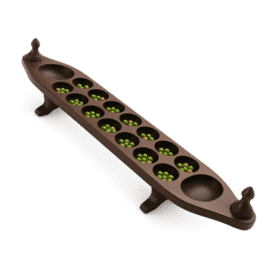 Congkak (también conocido como Sungka o Chongka, entre otros) es un juego de siembra en varias rondas, probablemente derivado del Mancala en el siglo XV.
La mayoría de los tableros de Congkak o Sungka tienen siete hoyos en cada uno de los dos lados, con un almacén en cada extremo del tablero para cada jugador. Sin embargo, algunos tableros tienen más o menos hoyos. Cada lado del tablero pertenece a un jugador. Los tableros suelen estar hechos de madera y tallados con diferentes diseños. Las semillas son caracolas (cowries), aunque se pueden usar otros objetos.
El juego se juega de manera similar al Mancala, con algunas diferencias importantes. El objetivo es obtener la mayor cantidad de semillas. La partida comienza con siete semillas en cada hoyo. Los jugadores consiguen semillas colocándolas en su almacén. Ambos jugadores realizan el primer turno simultáneamente. Durante el turno de un jugador, este recoge las semillas de un hoyo de su lado del tablero y va dejando una semilla en cada hoyo en sentido horario, colocando también una semilla en su almacén, pero saltándose el almacén del oponente. Si un jugador deja la última semilla en un hoyo que ya contiene semillas, recoge todas las semillas de ese hoyo y continúa su turno, distribuyendo las semillas recogidas en otra vuelta. Si la última semilla cae en un hoyo vacío de su propio lado, el jugador captura todas las semillas del hoyo correspondiente del lado del oponente (así como la semilla que colocó en el hoyo vacío). El turno de un jugador termina cuando una semilla cae en un hoyo vacío, sin importar de qué lado sea. La partida continúa hasta que todos los hoyos de un lado del tablero quedan vacíos. Si aún quedan semillas en el otro lado, el jugador dueño de ese lado se queda con todas esas semillas.
Las partidas también se pueden jugar por rondas. Al final de cada ronda, cada jugador llena cada hoyo de su lado con las semillas que tenía en su almacén; cada hoyo recibe siete semillas como en la preparación inicial. Las semillas sobrantes permanecen en su almacén. Si no hay suficientes semillas para llenar un hoyo, este se quema y se retira del juego. Los jugadores no pueden colocar semillas en un hoyo quemado. La serie de rondas termina cuando un jugador ya no puede llenar suficientemente un hoyo con siete semillas.
Número de jugadores: 2
Duración de la partida: 10 mn
Complejidad: 1 / 5
Juega Congkak y 1414 otros juegos en línea.
No es necesaria ninguna descarga - juega directamente desde tu navegador.
Con tus amigos y con miles de jugadores del mundo entero.
Libre.

Juega Congkak y 1414 otros juegos en línea.
No es necesaria ninguna descarga - juega directamente desde tu navegador.
Con tus amigos y con miles de jugadores del mundo entero.
Libre.
Sumario de reglas
OVERVIEW
Congkak is a 2-player mancala style game. The board has 2 large grooves on its left and right ends (storehouses), with 14 small holes in between (7 on each side). The game begins with 7 stones in each of the small holes and nothing in the storehouses. The storehouse to your left is yours, as are the 7 small holes nearest to you. Your goal is to have the most stones in your storehouse at the end of the game.
HOW TO PLAY
FIRST ROUND ONLY:
Each player chooses a hole on their own side of the board. The stones from these holes are SIMULTANEOUSLY redistributed around the board by placing one stone in each hole CLOCKWISE until all stones have been distributed. You will place a stone in your storehouse, in passing, but never in the opponent's storehouse.
Depending on where your last stone is placed, take the following actions:
1 - YOUR OWN STOREHOUSE: at the end of the board: Choose any hole on your side of the board, scoop up all of its stones, and again redistribute them around the board.
2 - ANY OCCUPIED HOLE: Regardless of which side of the board you end, if there are stones in that hole, scoop them all up, and again redistribute them around the board.
3 - EMPTY HOLE ON YOUR SIDE: Scoop up all of the stones on the opposite side of the board and place them into your storehouse. Your turn is over.
4 - EMPTY HOLE ON THEIR SIDE: Your turn is over.
SUBSEQUENT ROUNDS:
The player who finished their opening moves first will play first after their opponent is done. Then turns alternate between players. Only the first round is simultaneous.
GAME END
Play until all of the small holes on ONE side of the board are empty, but be careful: all remaining stones go into their owner's storehouse!
MULTIPLE ROUND OPTION
If playing more than one round, you will use the stones in your storehouses to reseed your side of the board. Distribute the stones evenly amongst the holes, up to 7 stones per hole.
~ Any stones left over go back into your storehouse. ~ If you don't have enough stones to fill a hole (it is empty), it is considered "burnt" and anyone's pieces that land in it automatically go to their opponent!
The loser of the previous round goes first. There is no simultaneous opening move.
Game ends when all of the houses are empty on either side of the board. Player with the most stones wins.