
Habitats
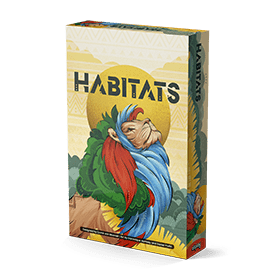 En Habitats, cada jugador construye un gran parque natural sin jaulas ni vallas. Los animales de tu parque necesitan sus hábitats naturales: praderas, matorrales, rocas o lagos. La cebra necesita una gran extensión de hierba y algo de agua cerca, por ejemplo, mientras que el murciélago necesita rocas, matorrales y agua, el ciervo necesita matorrales y hierba, y el cocodrilo necesita principalmente agua. Hay una serpiente, un babuino, una abeja, un elefante, una nutria, un lagarto, una tortuga, un águila, una suricata, un escorpión, un jabalí, un bagre, un rinoceronte, etc., cada uno con sus propios requisitos de paisaje — 68 animales diferentes en total.
Cada jugador comienza su parque individual con una loseta de entrada, y cada uno está representado en el mercado de losetas de animales por una figura de cerámica (o un meeple de guardabosques de madera en algunas ediciones). En su turno, un jugador coge la loseta a su izquierda, derecha o frente; mueve su figura al espacio que acaba de dejar libre; luego, roba una loseta para colocarla donde su figura comenzó el turno.
Al añadir una loseta de animal a tu parque, también añades su paisaje principal — el espacio base para el animal — a tu parque. Al colocar este nuevo animal, su propio paisaje puede ayudar a satisfacer las necesidades de tus otros animales, por ejemplo, el agua de una loseta de hipopótamo satisface la necesidad de agua de la nutria adyacente. Por lo tanto, satisfacer el deseo de tierra de cada animal se convierte en una tarea cada vez más difícil con cada loseta que añades.
Además de ampliar tu parque con diferentes tipos de paisajes, flora y animales, puedes mejorar su rentabilidad construyendo caminos de entrada adicionales, lugares de senderismo y torres de vigilancia.
Habitats dura tres estaciones, y en cada una de ellas cada jugador recibe entre 6 y 9 losetas nuevas para sus parques. Quien haya cumplido mejor el objetivo de la estación recibe puntos de bonificación, y el segundo y tercer clasificados obtienen un número menor de puntos. Al final de la partida, cada jugador anota puntos por cada loseta de su parque en función de si se cumplen los requisitos de dicha loseta. ¡Quien consiga más puntos gana!
Número de jugadores: 1 - 5
Duración de la partida: 17 mn
Complejidad: 2 / 5
Juega Habitats y 1414 otros juegos en línea.
No es necesaria ninguna descarga - juega directamente desde tu navegador.
Con tus amigos y con miles de jugadores del mundo entero.
Libre.


Juega Habitats y 1414 otros juegos en línea.
No es necesaria ninguna descarga - juega directamente desde tu navegador.
Con tus amigos y con miles de jugadores del mundo entero.
Libre.
Sumario de reglas
Zebras need grassland, gorillas need forest, crocodiles need water, ants need desert, and warthogs need a little bit of everything! Your duty as a wildlife ranger is to provide the habitats necessary for the animals in your African wildlife preserve to thrive. You will also be building watchtowers, access gates, campsites, and tourist spots to stand out as the best preserve in Africa.
Gameplay
The game is played over three years, each lasting the number of turns as indicated on the year marker. Turns proceed clockwise. Each turn you will “Take, Drive, Draw, Place”.
1. Take a Preserve Tile
from directly in front of or on either side of your jeep. You may NOT take the Preserve Tile behind your jeep unless you have no other legal tile to take.
If a jeep is in one of your legal spots to take from, you may take the next tile in that direction.
2. Drive Your Jeep
into the newly empty space, orienting it such that it is driving away from the space it previously occupied.
3. Draw a Preserve Tile
from the bag and place it in the spot your jeep just left.
4. Place the Preserve Tile
you took in step 1 in your Preserve. It must be placed next to an adjacent tile. Tiles with white borders represent the edge of your preserve. No tiles may be placed adjacent to those borders.
In Habitats, adjacent always means orthogonally adjacent, never diagonally.
Camps, Gates, and Watchtowers may be rotated in any direction when placed in a player’s preserve
The start player uses the Turn Tracker to track how many turns they have taken.
Habitats
Tiles are considered to be part of a “Habitat” if they have the same terrain type and are adjacent. Grey background tiles have no terrain type and cannot form a habitat.
Some Preserve Tiles have two terrain types and can extend multiple habitats
Year End
After each player has completed the number of turns shown on the Year Track, the year ends and that year’s two Goal Tiles are scored.
Each Goal Tile specifies a criteria. Score points based on how you rank against your opponents. The exact number of points is shown on the Year Track. In case of a tie, all tied players score the lower point value.
Record players scores on the score board, then reset the turn tracker and play the next year, continuing clockwise in the same turn order.
Game End
After Year 3 is scored, score end game points.
Place Score Markers on Animal, Gate, or Camp tiles when you satisfy their scoring conditions to keep track of which tiles will score.
The player with the most points wins. If tied, all tied players win.
Animals
Animals have required terrain icons.
The Animal scores the points on the tile only if it is adjacent to Habitats that contain the required terrains. The terrain on the animal tile itself does not count.
The Bee, Bumblebee, and Butterfly are slightly different because they require adjacent Flowers instead of terrain. They can be adjacent to the flowers or a group of flowers that are adjacent to each other.
Watchtowers
Watchtowers score the points shown for each scoring Animal or Flower in the designated tiles. Remember you can rotate the tile any direction when adding it to your preserve.

Flowers
Flowers always score 1 point.
Tourists
Tourists score based on having tiles of the same terrain type.

Gates
Gates score the points on the tile only if all sides without a white border have a tile adjacent to them.
Camps
Camps score the points on the tile if every indicated adjacent side has a non-camp tile.
BGA Changes
- Drive and Draw are automatic steps
- Turn tracker is not used
- Tile scoring is done in real time, rather than at the end
- The Habitat scoped tourist tile has been changed to only score "other" tiles in the same habitat.
Common Mistakes
- Animals do not count for their own scoring. Even when their terrain type matches an adjacent tile.
- Camps only score when attached to non-camp tiles. Connecting 2 camps prevents them both from scoring.
- Watchtowers only give points for Scored animals. Incomplete animals grant no watchtower points.