
Orchard
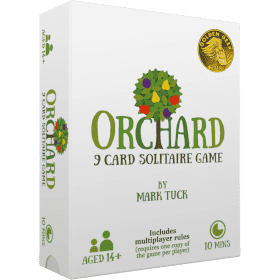 Orchard es un juego rápido de colocación de losetas en solitario que se juega en menos de 10 minutos. El objetivo del juego es recoger fruta (ganar puntos) jugando cartas de modo que sus árboles frutales se solapen con otros árboles del huerto que den la misma fruta. Cuantos más árboles consigas solapar, más fruta recogerás.
Además de los 15 dados que representan tu creciente cosecha, hay 2 fichas que representan fruta podrida. Estas fichas te permiten colocar una carta que de otro modo no podrías, pero conllevan una pérdida de puntos. Así que debes decidir si jugarlas y cuándo.
Número de jugadores: 1
Duración de la partida: 11 mn
Complejidad: 1 / 5
Juega Orchard y 1414 otros juegos en línea.
No es necesaria ninguna descarga - juega directamente desde tu navegador.
Con tus amigos y con miles de jugadores del mundo entero.
Libre.

Juega Orchard y 1414 otros juegos en línea.
No es necesaria ninguna descarga - juega directamente desde tu navegador.
Con tus amigos y con miles de jugadores del mundo entero.
Libre.
Sumario de reglas
Orchard
Orchard is a solitaire card-layering game where the player aims to harvest as much fruit as possible by overlapping fruit tree cards. The more trees of the same type you stack, the more fruit (points) you harvest.
Game Objective
Earn the highest score by placing cards so that identical fruit types overlap. The game ends when all 9 cards in the deck have been played.
Game Setup
- The game consists of 18 cards, but only 9 cards are used for a single session.
- One card is placed face-up as the starting card.
- The player draws 2 cards as a starting hand.
Gameplay
The game consists of several turns until the hand cards and draw pile are exhausted. A turn follows these steps:
1. Place Card (Overlapping)
- Choose one of your two hand cards and place it on the card(s) already in play. At least one square must overlap.
- Matching Trees: If you place a tree on another tree of the same type (same color/fruit), you harvest fruit.
- Mismatched Trees: You are allowed to overlap different fruit types, but this requires a Rotten Fruit Marker (see "Special Actions").
2. Mark Harvest (Using Dice)
- When fruit types match, place a die of the corresponding color on the square:
- First Overlap: Place the die showing value 1.
- Second Overlap: Turn the die to value 3.
- Third Overlap: Turn the die to value 6.
- Fourth Overlap: A basket symbol (or value 10) marks the maximum.
- Every time a new card is played, increment the values on the covered squares accordingly.
3. Draw
- Draw a card from the deck to maintain a hand size of 2.
Special Actions: Rotten Fruit
- If you place a card so that a fruit type overlaps a different type, you must place a Rotten Fruit Marker (black marker) on that square.
- Restriction: You only have 2 of these markers per game. Once both are used, you can no longer overlap mismatched trees.
- Penalty: Each rotten fruit on the board scores -3 points at the end of the game.
Categories & Symbols Summary
- Fruit Types:
- Apple (Red)
- Pear (Yellow)
- Plum (Purple)
- Dice: Act as counters for the harvest on specific squares (Values: 1, 3, 6, 10).
- Rotten Fruit Markers: Enable strategic placement despite mismatches but cost points.
End of Game & Scoring
The game ends once the 9th card is placed.
- Sum all values of the dice currently visible in the orchard.
- Subtract 3 points for each Rotten Fruit Marker used.
- Compare your total to the scoring table (e.g., from "Novice" to "Master Pomologist").
Strategic Decision Factors
- Prioritize Higher Tiers: Since the scoring (1-3-6-10) is non-linear, it is often more beneficial to boost a tree to level 3 or 4 than to start many new level 1 squares.
- Marker Management: Only use rotten fruit markers if they allow you to achieve a high-scoring 6 or 10 harvest elsewhere on the same card.