
Pisanki
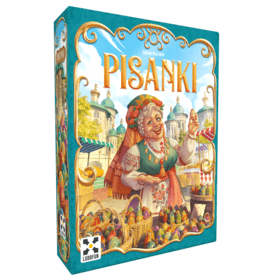 Pisanki es el arte tradicional de pintar huevos de pascua, celebrada por pueblos eslavos principalmente Polonia y Ucrania.
En este juego, vas a preparar la mejor presentacion de huegos Pisanki para deleitar a la gente alrededor del mundo.
Cada ronda, los jugadores revelaran y adquiriran nuevas cartas mostrando los huevos, flores y manteles decorados, para formar su tabla de presentacion.
Según el orden en que se adquieran las cartas, el jugador también podrá ganar puntos de movimiento para ordenar las cartas adquiridas en su mesa, que serán puntuados al final de la partida según su posición en relación a las demás cartas y según las cartas de puntuación fijadas al inicio de la partida.
El jugador con el mayor puntaje sera considerado el ganador.
Número de jugadores: 2 - 5
Duración de la partida: 7 mn
Complejidad: 1 / 5
Juega Pisanki y 1414 otros juegos en línea.
No es necesaria ninguna descarga - juega directamente desde tu navegador.
Con tus amigos y con miles de jugadores del mundo entero.
Libre.


Juega Pisanki y 1414 otros juegos en línea.
No es necesaria ninguna descarga - juega directamente desde tu navegador.
Con tus amigos y con miles de jugadores del mundo entero.
Libre.
Sumario de reglas
Pisanki - Quick Rules
Pisanki is a strategic card game where players collect and arrange decorated Easter eggs (Pisanki) on their display table to score the most points through clever positioning and majorities.
Gameplay Flow
The game lasts several rounds. Each round consists of the following phases:
1. Preparation Phase
- Depending on the number of players, cards are drawn from the deck and placed face-up next to the numbered Offer Cards (1 to 5).
- These cards feature combinations of eggs, flowers, and different tablecloth backgrounds.
2. Acquisition Phase
- Starting with the lead player, each player chooses one of the available cards.
- Choosing a lower-numbered card grants a better turn order position for the next round.
3. Placement and Sorting Phase
- The acquired card must be placed immediately into the player's Display Table (a 3x4 grid).
- Using Movement Points:
- If the player purchased 1 card, he will have 2 moves to make
- If the player purchased 2 card, he will have 1 move to make
- 1 move:A card can be moved vertically or horizontally to any position in that direction; the other cards in the column or row must be slid to fill the empty space.
- 2 Points: The same card can be moved twice (if the player has 2 moves).
Categories and Symbols
When choosing cards, players should consider these key elements:
- Egg Types: There are 6 different patterns/colors. These are vital for majority scoring.
- Flowers: Found on some cards. They provide bonus points based on the active Flower scoring cards.
- Tablecloths (Backgrounds): The color or pattern of the background influences tablecloth scoring (e.g., groups of matching colors).
- Double Eggs: Cards showing two eggs count twice for majority checks.
End of Game and Scoring
After 12 rounds, the 3x4 display is full. Scoring occurs in four categories:
- Egg Majorities: The player with the most eggs of a specific type wins the points on the corresponding scoring card.
- Flower Scoring: Points based on the total number of flowers collected.
- Tablecloth Scoring: Points for the arrangement and patterns of the card backgrounds.
- Display Scoring: Points for meeting specific objectives (e.g., specific eggs in the corners of the grid).
The player with the highest total score wins.