
Seotda
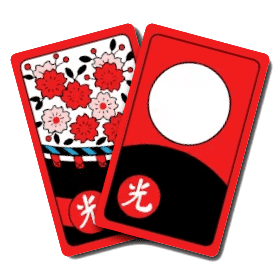 Seotda (también conocido como Sutda) es un juego de cartas de apuestas coreano similar al Oicho-Kabu. Inicialmente jugado con Tujeon, hoy en día el juego usa Hwatu o Hanafuda en su lugar. Los jugadores apuestan por el valor de sus cartas repartidas en varias rondas como el Póquer u otros juegos de confrontación. Las manos Seotda consisten en 2 cartas.
Esta implementación también soporta Dorijitgo-ttaeng, que exige a los jugadores formar una combinación de 3 cartas cuyo valor total sea dividible por 10 y luego usar las dos cartas restantes de su mano de 5 cartas.
Las imágenes de Hwatu de Marcus Richert y las imágenes de Hanafuda de Louie Mantia Jr. se utilizan bajo la licencia de arte libre 1.3, que es compatible con la licencia CC BY-SA 4.0.
Los efectos de sonido Hwatu de JICA (Jeonju) se utilizan bajo la Licencia de Gobierno Abierto de Corea Tipo 1.
Número de jugadores: 2 - 8
Duración de la partida: 5 mn
Complejidad: 1 / 5
Juega Seotda y 1408 otros juegos en línea.
No es necesaria ninguna descarga - juega directamente desde tu navegador.
Con tus amigos y con miles de jugadores del mundo entero.
Libre.

Juega Seotda y 1408 otros juegos en línea.
No es necesaria ninguna descarga - juega directamente desde tu navegador.
Con tus amigos y con miles de jugadores del mundo entero.
Libre.
Sumario de reglas
Game Overview
In the high-stakes world of Korean gambling, players face off in Seotda, a tense battle of luck and psychological warfare. Thematically, you act as a bold gambler aiming to create the most powerful combination using only two cards. Mechanically, the game utilizes a condensed Hanafuda deck where strategic betting and calculated bluffing are essential to force opponents to fold before the showdown.
Goal of the Game
The goal is to hold the highest-ranking combination of two cards or to win the pot by bluffing opponents into folding.
Gameplay
Preparation
- A reduced deck of 20 Hanafuda cards is used (months 1 through 10, two cards per month).
- Each player is dealt 2 cards (in the 3-card variation, one card is discarded before the final bet).
Betting Phase
Once cards are dealt, players choose their actions:
- Die: Fold and forfeit the current stake.
- Call: Match the current bet.
- Raise: Increase the stakes.
- All-in: Bet all remaining capital.
End of Round
If multiple players remain after the betting phase, a showdown occurs. Hands are revealed, and the player with the strongest combination takes the entire pot.
Combinations (Ranking)
| Rank | Name | Description |
|---|---|---|
| 1 | 3-8 Gwang-ddeng | The ultimate hand, consisting of the special cards from months 3 and 8. |
| 2 | 1-3 / 1-8 Gwang-ddeng | The second-highest tier (special cards from months 1 & 3 or 1 & 8). |
| 3 | Ddeng | Two cards from the same month (e.g., two 10s = Jang-ddeng). |
| 4 | Ggeut | The sum of the two cards' months (last digit only). A 9 is the highest standard value (Gabi). |
Game End & Scoring
- The game ends after a fixed number of rounds or when only one player has capital left.
- Re-deal: In the event of a tie for the highest hand, the pot is typically carried over to the next round rather than split.