
The Guild of Merchant Explorers
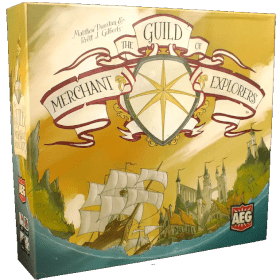 En The Guild of Merchant Explorers, cada jugador comienza con una ciudad en su tablero personal de mapa.
Baraja el mazo de cartas de terreno y luego revela la mayoría de estas cartas una por una. Según el terreno revelado, cada jugador coloca en su tablero cubos que están conectados a su ciudad inicial o a otros cubos. El objetivo es completar áreas en tu tablero, cruzar los mares hacia nuevas tierras y establecer nuevas ciudades en el mapa. Puedes explorar barcos hundidos para obtener tesoros, lo que te otorga capacidades especiales de colocación, y crear conexiones vinculadas entre ubicaciones para obtener puntos extra. Los objetivos comunes pueden ser completados por todos los jugadores, pero aquellos que los completen primero ganarán más puntos.
Al final de cada ronda, todos los cubos se eliminan de cada tablero, dejando solo las ciudades, por lo que si no estableces nuevas ciudades, te quedarás en los mismos lugares.
The Guild of Merchant Explorers incluye múltiples copias de cuatro mapas diferentes, y el juego está diseñado para que puedas jugar de manera remota con una o más copias.
En The Guild of Merchant Explorers, cada jugador comienza con una ciudad en su tablero personal de mapa.
Baraja el mazo de cartas de terreno y luego revela la mayoría de estas cartas una por una. Según el terreno revelado, cada jugador coloca en su tablero cubos que están conectados a su ciudad inicial o a otros cubos. El objetivo es completar áreas en tu tablero, cruzar los mares hacia nuevas tierras y establecer nuevas ciudades en el mapa. Puedes explorar barcos hundidos para obtener tesoros, lo que te otorga capacidades especiales de colocación, y crear conexiones vinculadas entre ubicaciones para obtener puntos extra. Los objetivos comunes pueden ser completados por todos los jugadores, pero aquellos que los completen primero ganarán más puntos.
Al final de cada ronda, todos los cubos se eliminan de cada tablero, dejando solo las ciudades, por lo que si no estableces nuevas ciudades, te quedarás en los mismos lugares.
The Guild of Merchant Explorers incluye múltiples copias de cuatro mapas diferentes, y el juego está diseñado para que puedas jugar de manera remota con una o más copias.
Número de jugadores: 1 - 4
Duración de la partida: 15 mn
Complejidad: 2 / 5
Juega The Guild of Merchant Explorers y 1414 otros juegos en línea.
No es necesaria ninguna descarga - juega directamente desde tu navegador.
Con tus amigos y con miles de jugadores del mundo entero.
Libre.


Juega The Guild of Merchant Explorers y 1414 otros juegos en línea.
No es necesaria ninguna descarga - juega directamente desde tu navegador.
Con tus amigos y con miles de jugadores del mundo entero.
Libre.
Sumario de reglas
Goal
The goal of the game is to earn as many coins as possible. Players earn coins by placing explorers on cities, ruins, or discovery towers. Players can also create trade routes between cities, the capital, or other villages.
Gameplay
The game consists of 4 eras. In each era, players will take simultaneous turns after revealing explore cards until the exploration deck is exhausted.
At the end of each era:
- All explorers (cubes) are removed from the maps. Villages, trading posts, treasure tokens, and discovery towers are left on each player's maps.
- The next era's explore card is added to the exploration deck.
The game ends at the end of the 4th Era and the player with the most coins wins.
Spaces
There are 4 basic terrains to explore:
- Grassland
- Desert
- Mountain
- Sea
Each terrain space can be 1 of 5 different types:
Blank Spaces
Empty spaces where Villages may be placed.
Coin Spaces
Earn coins when explored.
Ruin Spaces
Special sea terrain; earn a Treasure Card when explored.
City Spaces
Connect 2 City Spaces to create a trade route.
Discovery Spaces
Special "wild" terrain; earn coins when explored.
Exploration cards
There are 5 basic exploration cards that will be available in every era:
- Explore one mountain space
- Explore up to two desert spaces (need not be adjacent)
- Explore up to two grassland spaces (need not be adjacent)
- Explore up to three sea spaces (must be adjacent and in a straight line)
- Explore up to two spaces of any terrain (must be adjacent; need not be the same type)
In addition, there is an era card for each era. The card(s) for the current and all previous eras will be shuffled into the exploration deck with the five basic cards.
The first time each era card is drawn, each player will draw two cards from the investigate deck and choose one to keep. They will use the associated special exploration action every time that era card is drawn, immediately and in future eras.
The fourth era card is special. Instead of drawing new investigation cards, each player will choose one of their existing investigation cards from eras I, II, or III to use. That action will be used immediately, as well as when its own card is drawn.
Placing explorers
Players may simultaneously place explorers based on the currently revealed explore card.
Players must place their explorers directly adjacent to the following:
- The capital space
- Previously placed explorers
- Player villages
Place explorers one at a time. All special actions (below) occur immediately upon placing the necessary explorer. If there are still explorers to be placed, they will continue to be placed after the action is completed.
Discovering villages
Discover new villages by fully exploring a region in a single era.
A region is a contiguous group of tiles of the same terrain.
When a region is fully explored for the first time, immediately replace an explorer on one of the blank tiles in that region with a village. Then, score coins equal to the current era.
Each region may only have one village.
Villages will not be removed at the start of each era, as opposed to explorers.
Creating trade routes
Connecting 2 city spaces creates a trading route. Cities can be connected with a chain of explorers, villages and/or your capital.
When creating a trade route, multiply the values of both cities and gain that amount of coins.
Then, cover up one of these cities with a trading post. This city can not be part of a trading route anymore.
Discovery spaces and towers
Discovery spaces are "wild" terrain, which means it can be explored with any type of exploration action.
When explored, gain coins based on how many other Discovery Spaces have been explored by the player (6/8/10/14).
Then, cover up the space with a Tower. This space can not be scored again.